
Inside Our Kitchen: How Delightfully Delicious Dog Treats Are Actually Made
People ask us a version of the same question all the time: what actually makes a dog treat "all-natural," and how is a small bakery in Western New York different from the bag on the grocery store shelf? It is a fair question. The label on the front of a package is marketing. What matters is what happens between the ingredient bin and the sealed bag.
So this one is a walk through our own kitchen. No secrets held back, no mystery process. Just how a batch of Delightfully Delicious treats actually gets made, and why we do it the slow way.
It Starts With a Short Ingredient List
Every batch begins with the same rule: if we would not want it in our own pantry, it does not go in the mixer. That means no corn, no wheat, no soy, and no artificial preservatives to stretch shelf life.
What is left is short and recognizable. Oat and rice flours. Real pumpkin. Real apple and cinnamon. Peanut butter. The kind of list you can read out loud without stumbling. There is nothing exotic about it, and that is the point — a treat is a small part of a dog's day, and it should not be the most complicated food in the house.
The short list has a practical benefit too. When a dog has a sensitive stomach or a suspected food sensitivity, fewer ingredients means fewer variables. Owners can actually figure out what agrees with their dog instead of guessing at a paragraph of unpronounceable additives.
Mixing: Dough, Not Slurry
Our treats start in a floor mixer, the same style of machine a bread bakery uses. Dry ingredients go in first, then the wet, and the paddle works it into a stiff, cohesive dough — closer to a shortbread than a batter.
Getting that texture right is most of the job. Too wet and the pieces spread and lose their shape on the tray. Too dry and they crumble at the edges and turn into dust in the bag by the time they reach a customer. The person running the mixer is watching how the dough climbs the paddle and how it holds a shape when squeezed, adjusting for things like humidity, which in a Rochester-area summer is not a small factor.
This is also the step you cannot fully automate. A machine can run for a set number of minutes. It cannot look at the dough and decide it needs another thirty seconds.
Shaping and Baking, Tray by Tray
From the mixer, the dough goes through a sheeter and cutter that rolls it to an even thickness and stamps out our bone shapes onto perforated sheet pans. Even thickness matters more than it sounds like it should — a tray of pieces that vary in height bakes unevenly, which means some are soft in the middle while others are overdone.
Then the trays go into the oven. Oven-baked is a phrase we use deliberately. A lot of mass-produced treats are extruded, cooked under pressure at high heat, and pushed out in a continuous rope before being cut. That process is fast and cheap and works fine for volume. Baking is slower. It also gives you the dry, snappable texture dogs get excited about and lets the actual flavor of pumpkin or peanut butter come through instead of being cooked flat.
After baking, trays cool on racks. We do not rush this either. Warm treats sealed into a bag create moisture, and moisture is how a preservative-free product goes bad. Full cooling is what lets us skip the chemical shelf-life extenders entirely.
Why Small Batches Are Worth the Trouble
Baking in small batches costs more per treat than running one enormous production line. We keep doing it for three reasons.
First, quality control is real instead of theoretical. When a batch is a manageable number of trays, someone actually looks at every tray. Broken pieces and overbaked edges get pulled out rather than averaged into a giant lot.
Second, freshness. Small batches mean product moves. Nothing sits in a warehouse for a year waiting for demand to catch up, which matters enormously when you are not using preservatives.
Third, flexibility. If a customer tells us their dog does great on the pumpkin but not the peanut butter, that feedback can actually change what we bake next week. That does not happen at industrial scale.
The Flavors, and What They Are Good For
Pumpkin is our most-requested, and for good reason. Pumpkin is a familiar, gentle source of fiber, which is part of why so many dog owners already keep a can of it in the cupboard. Our Pumpkin treats put that in a shelf-stable, biscuit form.
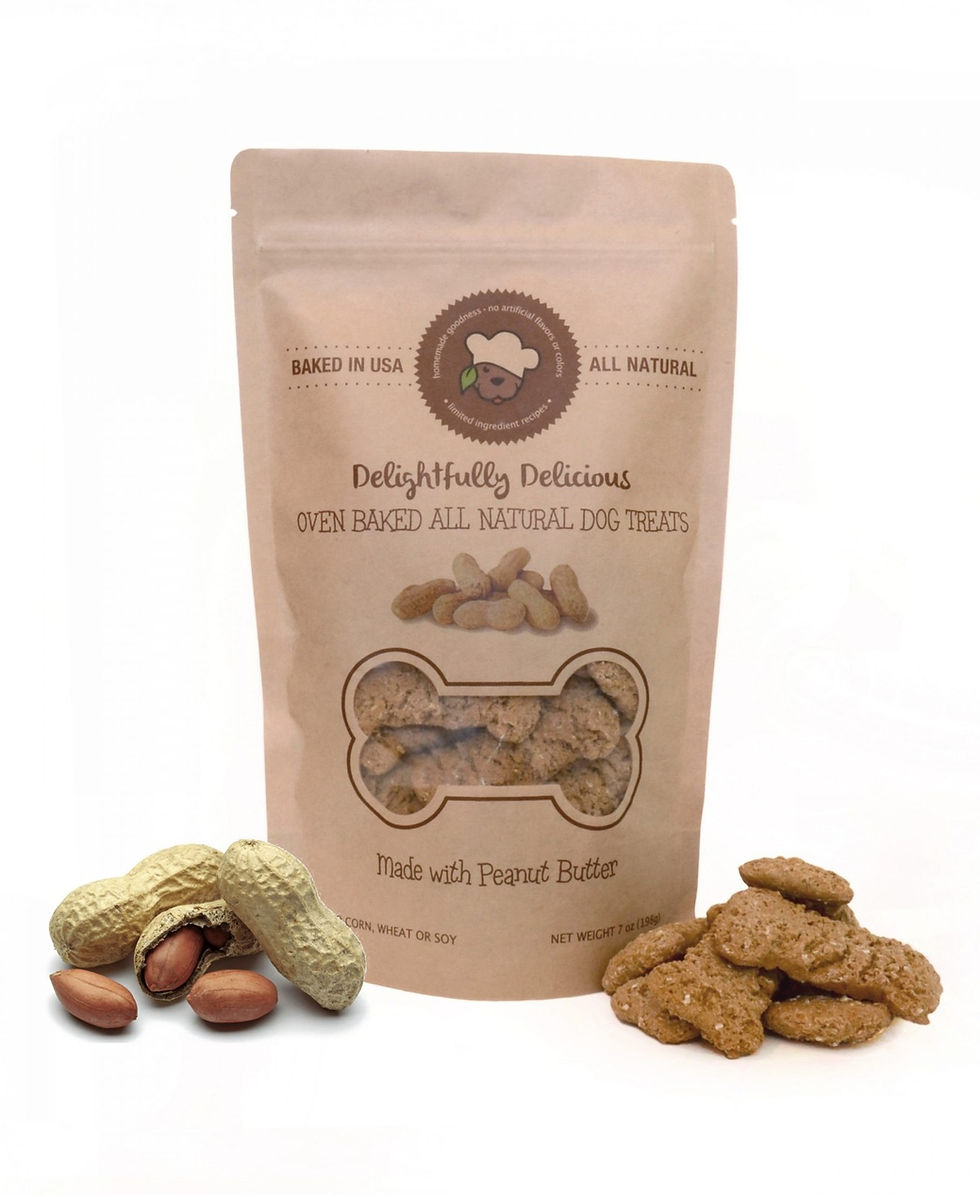
Peanut Butter is the crowd-pleaser and the workhorse for training. It is the flavor most dogs will work hardest for, and the biscuits break cleanly into small pieces, which is what you want when you are handing out twenty rewards in a fifteen-minute session rather than one big cookie.
Apples and Cinnamon is the seasonal favorite, and around here it is basically a fall requirement. Real apple, real cinnamon, and a smell that makes the whole kitchen better while a batch is baking.
All three are made in the same simple way and portion the same, so switching between them is not a diet change in any meaningful sense. Rotate them if your dog gets bored, or stick with the one they love.
It Is Not Only Treats
The same philosophy carries into the rest of what we make. Our natural paw protection wax uses beeswax and food-grade oils to put a breathable barrier between a dog's pads and hot pavement in July or salted sidewalks in January. Our unscented dog soap skips the heavy fragrance loads that irritate sensitive skin.
The through-line is the same as the treats: fewer ingredients, all of them ones you can identify, made in quantities small enough that a person is paying attention.
How We Think About Portions
One more thing worth saying, because it comes up constantly. Treats are supposed to be a small slice of what a dog eats in a day, not a second dinner. The general guidance most veterinarians give is to keep treats to roughly ten percent of daily calories, with the rest coming from a complete diet.
That is easier to manage with a biscuit you can snap into halves and quarters than with a big rich chew. For a small dog, a single piece broken into four rewards can carry an entire training session. For a large dog working outside in cold weather, a whole biscuit is reasonable. If you are handing out a lot of treats during a training push, trim the dinner bowl slightly that week and watch your dog's waistline rather than the scale.
What to Look For on Any Label
Even if you never buy from us, this is worth knowing. Turn the bag over. Read the first five ingredients, since those make up most of the product. Look for named ingredients rather than categories — "pumpkin" instead of "vegetable derivatives." Be skeptical of long lists with multiple preservatives you have to look up. Check whether it says baked or extruded. And note where it is made.
A good dog treat is not complicated. It is a small number of decent ingredients, baked properly, packaged after it has cooled, and sold before it goes stale. Everything else is decoration.
Come See What We Bake
We are proud of how these treats are made, and we would rather tell you than hide behind a label. If you have questions about ingredients, sourcing, which flavor suits a sensitive stomach, or wholesale for your own shop, get in touch — email info@ddtreats.com or call 1-800-249-8732. You can also browse the full lineup of oven-baked, all-natural treats and dog care goods right here on our site.


Comments